I love talking my patients. They are my lifeline to the real world out there – (you know the one where most people don’t spend all day every day thinking about teeth!)
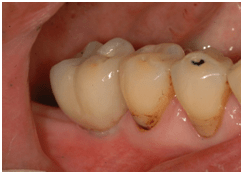
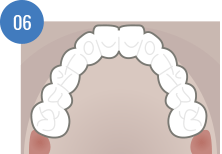
This lady is one of my long standing dental implant patients – a few years ago we completely rebuilt her upper teeth using custom porcelain bridges supported on titanium implants
The thing is, they look as good today as the day we fitted them all that time ago. But this is no accident. This lady follows Laura’s (one of our lovely hygienists – yes they’re out there, honest!) advice to the letter. She cleans the bridges and implants twice a day, and visits us every 6 months for her Healthy Mouth Review to allow us to monitor the health of her mouth and implants, to clean those areas even she can’t get to, and to carry out our Oral Cancer Check.
This is routine at Winning Smiles.
Implants need as much – possibly more – upkeep than natural teeth…they are a great copy of the real thing (better than a chinese rolex) but even I don’t claim to have beaten mother nature at her own game!
So when Gill told me yesterday that she is coming across more and more people who are benefiting from this sort of dental treatment – but some of them can’t understand why she has to keep coming back to see us for what they see as ‘unnecessary maintenance’, I had to press her for further clarification! ‘Why?,’ I said. And Gill went onto explain that these patients are popping into dental practices (yes in the UK) and having implants placed ‘as if they are just expensive fillings’!
This is a worrying trend. Problems with dental implants rarely cause pain, so for a patient who has been advised in this way the first time they realise there is a problem with their dental implants might be the day they fall out! The fact that this may take 5-10 years is what is protecting both these dentists (and their patients – ignorance is bliss) for the time-being. But it’s a ticking time-bomb. These cheap ‘quick-fit’ (and forget) implants have been placed in the last couple of years as more and more of the profession learn about them – in response to greater and greater demand from patients….alas it is only a matter of time before the chickens come home to roost. And when they do, the only winners (as usual) will be the lawyers.
Leaving the cost issue aside, once implants fail it is not nearly as easy to do them a 2nd time. The bone around them disappears – which is why they fall out – so if they fall out, by definition there is often no bone left to put another one in….and this puts us right back to the 1970s: dentures for all.
It should be fairly obvious that in order to fit dental implants safely and successfully, you need to have a skilled and experienced surgeon. But did you know just how much the procedure also relies on having incredibly precise 3D images of the jaw bone? These are the X-ray images that allow the surgeon to plan the exact position and placement of an implant and they make sure that:
-the implants don’t ‘hit’ any vital structures during insertion (like arteries and nerves)
-the implants are placed so that the final implant crown or bridge ends up in the right position in the mouth
So what are the consequences of getting this wrong?
-a numb lip (possibly forever)
-a haemorrhage during surgery
-teeth ending up in the wrong place and looking ‘goofy’!
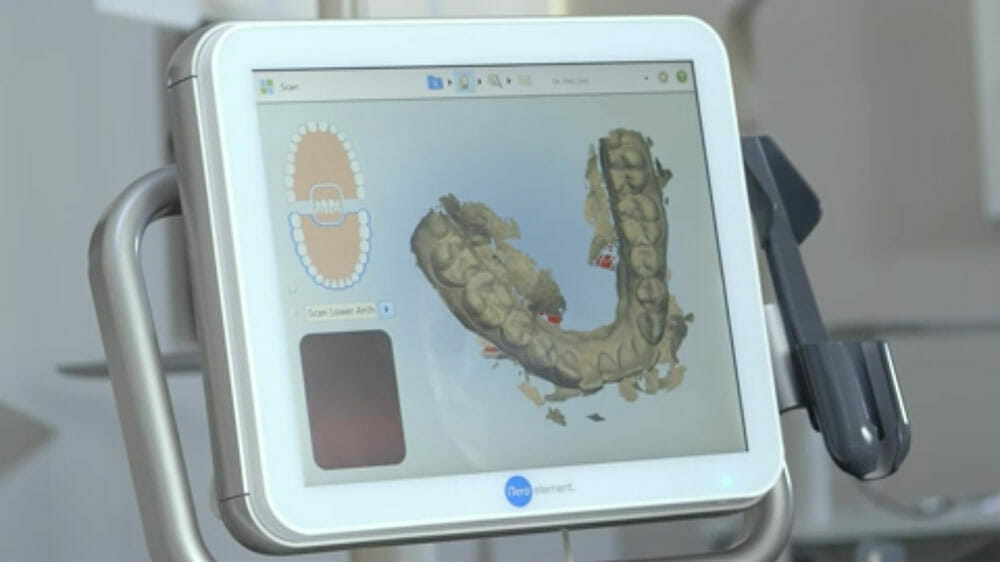
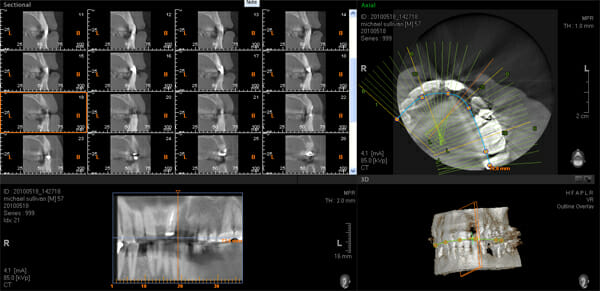
At Winning Smiles we know how crucial this precise 3D imaging of the jaw bone is. That’s why we use the latest Specialist Dental CT scanner to produce 3D images of the jaws before surgery. These machines provide superb high resolution, high definition images. Armed with this level of information we have safely and successfully fitted around 600 dental implants in the last few years.
And because the new generation of ‘cone beam’ dental CT units work with a radiation dose many times below that of hospital CT Scanners, they are not only more convenient (the whole procedure can be carried out here at our clinic), but they are also much safer.
So if you’re looking for safe, convenient, successful implant surgery…..you can rest assured that that all comes as routine for you here.
An example screen grab from our Specialist Dental CT Scanner
It is quite common that patients who are considering, or about to undergo dental implant surgery to be in the dark when it comes to predicting how much pain to expect.
We hope this will help understand the implications from
a) the surgery itself
b) during the recuperation period immediately post-surgery (ie the next week or two)
And although at Winning Smiles we always encourage new implant patients to have a chat with patients who have had the whole ‘implant experience’, most patients won’t actually take us up on that offer – even though our previous implant patients are usually very happy to talk about it!
So I thought it might be useful to pen a broad classification of what pain and trouble you might expect from our implant procedures here at Winning Smiles. All implant surgery is not the same, so I have divided it up a bit (with a note on sinus surgery/bone grafts at the end)
1) Simple implant surgery ie 1-2 implants, no ridge splitting, no sinus work, no grafting
No need for sedation unless you are a nervous patient
Pain during surgery: none
Recuperation period: 2 days, mild soreness around gums, most patients will go back to work next day without the need to take even an aspirin.
2) ‘Middle of the road’ cases ie 3-4 implants or 2 implants with ‘extras’ like sinus surgery/sinus ‘tap up’/simple bone grafting/ridge expansion
Sedation recommended
Pain during surgery: none! (No, really!)
Recuperation: 3-10 days. Mild to moderate soreness around gums, mild swelling. Individual patients respond very differently in these cases.
For some patients it is very easy and they get only minor post-op soreness. At the other end of the spectrum a few patients will have to take painkillers for a few days and may bruise (in fair skinned patients the bruising can be quite noticeable).
3) Complex cases ie a whole upper jaw/lower jaw, 4-16 implants, ‘block’ bone grafts, etc
Sedation strongly recommended
Pain during surgery: none
Recuperation: 7-14 days. Moderate soreness around gums, moderate swelling, pain killers for the first week. Bruising can be quite widespread in fair skinned patients (ladies – buy concealer before you come!)
4) Sinus surgery:
no pain during surgery, little or no pain afterwards with mild swelling. Bruising on fair skinned patients.
5) ‘Block’ bone grafts – where we take bone from the chin or lower jaw and screw it into place somewhere else (often upper front area)
Ok, again we would expect no pain during the surgery but considerable soreness/bruising and some swelling for 1-2 weeks afterwards.
Similar to ‘complex’ cases above, it’s not something we enjoy doing to patients but in some cases the only way forwards – and they do work very well.
This is a lot of detail, but we find people would rather know these things up front, rather than find out after the event.
Andrew explains the pros and cons of the implants vs bridges argument and why he generally prefers to use dental implants to replace missing teeth these days. This is the blog about dental bridges referred to in the video.
Someone came to the surgery the other day, and this happens a fair bit, they apologised for their teeth.
It reminded me that I should put ‘something on the website’ about this, as we’re really not here to judge anyone and people should not feel the need to be embarrassed (even if it is human nature).
You see, its only when people really need us that we get to make the most difference.
And if its not too selfish of us, we’d be delighted to see you.
Just recently we’ve had an unusual number of patients coming in with serious problems with single front teeth. Perhaps it’s something in the Essex water!
Among the causes of these problems are
sports injuries (eg getting kicked in the face playing rugby)
‘other’ injuries (eg falling down the stairs or sliding on the ice)
old crowns that have failed and cracked the root
problems with old crowns with posts
problems with root filled teeth
in these cases extraction is often the only option.
In the past we would have had to wait months after extracting the tooth before putting the implant in, and then a few more months of waiting before the implant could have a tooth added to it…..6-9 months of waiting with a temporary bridge in place…
With Immediate Implant techniques we can often bypass this waiting time: if the bone is intact around the failing tooth and there is no infection present then we can (very) carefully extract the root (without damaging the socket walls) and put an implant directly into the tooth socket!
And if the implant is secure in the bone then we can even put the titanium post into place and put a temporary crown on top.
Where appropriate this treatment means that the patient can literally come to the clinic with a failed tooth and leave a short while later with their new implant tooth in place.
Is it possible to walk into a dental clinic and have all your old broken, unsightly teeth replaced with shiny white new ones supported by titanium implants all on the same day?
The answer is yes in many cases – providing the case has been prepared carefully in advance.
Over in the States ‘immediate implants’ (also known as ‘teeth in an hour’) are becoming commonplace, and this technique has been available for about 10 years or so.
Here in the UK we tend to take a rather more cautious approach to our dental implant treatment so a number of us have been waiting on the sidelines to see what the outcome of these more radical treatments was going to be…. In other words, “will it work long term?”
The answer is yes once again.
We now have enough long term data (over 5 yrs) to convince even the more conservative of us that;
immediate implant teeth work in the long term
in some cases doing it this way can improve the aesthetic outcome
this method can significantly reduce bone the bone shrinkage which occurs when teeth are extracted.
the immediate implant technique can be used on single, multiple or full mouth cases
So there it is. Viable and better, in many cases.
Once again, as with ‘Painless Injections’ the future has arrived, all you need is comprehensive surgical training, advanced surgical equipment, and an open mind…..for the dentist, that is. Our patients are often the people who inspire us to strive to give them these gold standards of dental treatment.
No one mention drive through dentistry though, or it’ll be time to hang up the rubber gloves.
Did you know that dental bridges have been around for over a century?
Now I’m not one to decry something simply because its getting old – for example, I do love old cars (as friends will testify!), but how many of us would drive a 100 year old car as everyday transport? Wouldn’t that be uneconomic, wouldn’t it damage the environment?
Just like having dental bridges fitted, as it turns out.
The costs add up
The problem is, a bridge relies totally on the teeth either side for its support, and those teeth have to be drilled down to pegs would you believe.
So, installing the dental bridge actually weakens the adjoining teeth, and then to add insult to injury, the bridge leans on them for the rest of its life…..the dental bridge is ‘parasitic’. Bad for its environment.
The extra loads that that bridge imparts means those teeth are much more likely to fail in the long term……a single tooth loss leads to having 2 or 3 teeth missing…the long term costs go up.
Hardly an elegant modern solution
People should also know that with a bridge, the bone and gum underneath continues to shrink slowly over time.
At best this leaves a ‘dip’ in the gum above the bridge tooth and at worst a black hole (gap) appears so that everyone you smile at knows exactly where your false tooth is!
Dental Implants are the answer
The humble dental implant solves all these issues: It stands alone without interfering with its neighbours.
Over and above that, our bone loves the titanium surface of an implant tooth – and once an implant is inserted under the gum and into the bone, then the bone will not shrink like it does with a bridge.
The aesthetic and cost implications of implant teeth are just too good to ignore.
Let us retire the bridge, and give it the rest it deserves.